

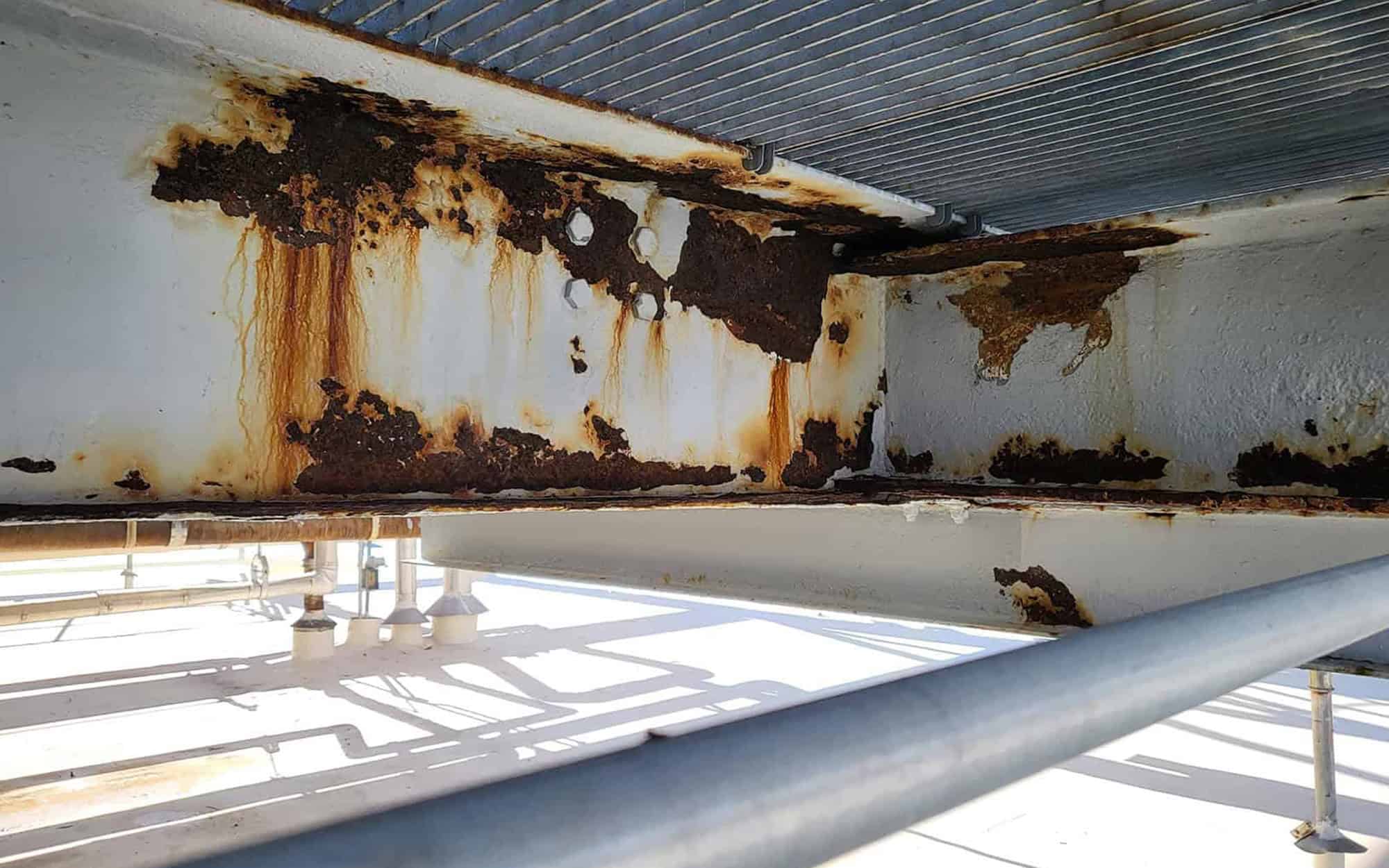
When an industrial coating fails ahead of schedule, the instinct is to blame the product. But in most cases, the product is not the problem. Understanding why industrial coatings fail on steel and concrete requires an honest look at what happened before the first coat went on, and in some cases, what happened during application as well.
The Importance of Surface Preparation for Industrial Coating Projects Are Won or Lost
Inadequate surface prep is responsible for the majority of premature industrial coating failures in the field, and in most of those failures the prep step was evaluated visually, approved by eye, and moved past too quickly. Knowing what properly prepared steel and concrete actually looks like is the foundation for any honest diagnosis of a coating that did not last.
Contamination
Steel and concrete surfaces in industrial environments collect oils, mill scale, salts, and chemical residue over time, and those contaminants are not always visible. When surface contamination is not fully removed before application begins, the coating bonds to the contamination layer rather than to the substrate itself. The result is industrial coating adhesion failure that shows up as blistering, edge lifting, or complete delamination.
Surface Profile
Adhesion on steel depends on a mechanical bond, or the coating physically gripping the peaks and valleys of the substrate created by blast cleaning. When the profile is too shallow, the coating sits on top of the substrate rather than gripping it, reducing adhesion. When it is too deep, there is not enough coating material to fill the valleys properly, creating thin spots that are the first points of failure.
On concrete, the same logic applies. Grinding, shot blasting, or acid etching is required to open the surface before any coating goes down, and the method matters based on what the coating system requires.
Moisture
Moisture is one of the most common and most underestimated drivers of industrial coating failure on both steel and concrete substrates. On concrete, hydrostatic pressure from below can drive blistering and delamination even when the surface appeared dry at the time of application.
On steel, surface rust or flash rusting between blast cleaning and coating application continues to develop beneath the film, eventually breaking the bond from underneath. Substrate dew point calculations and moisture testing are standard protocol for a reason, and skipping them is a gamble that industrial environments tend to penalize quickly.
Two-Component Mixing Errors and the Pot Life Problem
Many of the industrial coatings used on steel and concrete are two-component systems, which include an epoxy base and a hardener, a urethane and a catalyst, or more complex formulations with strict volumetric or weight ratios defined by the manufacturer.
Getting those ratios wrong is one of the most reliable ways to produce a coating that looks correct at application but fails structurally in service. When the ratio is off, the chemical reaction that creates the coating’s crosslinked structure does not complete properly, and the result is a film that may feel dry and appear cured but lacks chemical resistance and adhesion strength.
Pot life is the window of time after mixing during which a two-component product can still be applied and achieve its designed properties. A material applied past its pot life is chemically compromised before it contacts the substrate. High ambient temperatures shorten pot life faster than most crews expect, which is why on-site temperature and humidity monitoring is a process control requirement, not a formality.
QC Commercial’s crews work with high-performance coating systems across industrial and commercial projects in North Carolina, applying verified mixing protocols and ambient condition monitoring on every multi-component application.
Cure Time and Return-to-Service Are Not the Same Number
Cure time is the minimum window after application before the coating can handle any surface contact, and it’s typically measured in hours and listed on the product data sheet. Return-to-service time is longer, sometimes significantly longer, and represents when the coating has reached its full designed hardness, chemical resistance, and adhesion strength.
Putting a forklift on a freshly coated floor, returning a chemical storage tank to service, or loading an epoxy floor system with heavy pallet traffic before that return-to-service window closes compromises the structural integrity of the coating system.
Applying the Wrong Coating System for the Environment
The right system for an interior concrete floor in a food processing facility is not the right system for an exterior structural steel frame, a secondary containment basin, or a surface exposed to direct sunlight and thermal cycling. Getting this right requires knowing the actual exposure conditions, not just the general category of the facility.
UV Exposure
Standard epoxy coatings are not UV stable. Applied as a finish coat on exterior steel or concrete, they chalk, fade, and lose film integrity under direct sunlight. This is one of the most common industrial paint peeling causes on exterior structural steel. Urethane or polysiloxane topcoats are the correct finish coat for UV-exposed surfaces, with epoxy used as a primer underneath if the system calls for it.
Chemical Resistance Mismatch
Coating delamination causes on steel and concrete in chemical storage and secondary containment environments are frequently traced back to a coating specified for general industrial use. Matching the coating to the chemical exposure requires knowing what the facility stores and handles at the product level and specifying accordingly rather than defaulting to whatever the crew is most familiar with applying.
Thermal Cycling
Facilities with significant temperature variation put coatings under mechanical stress that rigid epoxy systems are not designed to sustain over time. As the substrate expands and contracts with temperature changes, a coating without adequate flexibility loses adhesion at edges, seams, and points of stress concentration. Flexible polyurethane and elastomeric systems are better suited to these environments, as they are engineered to move with the substrate.
Five Questions to Ask a Contractor Before the Next Application
Most quality failures in industrial coatings applications trace back to process variables that an experienced contractor controls, and those variables are things you can ask about before any work is scheduled. Any contractor who understands the process should be able to answer these without hesitation, and the answers will tell you quickly if you are dealing with someone who follows a documented system.
- What surface preparation standard are you following, and how will you verify it was met before application begins?
- What are the mixing ratios and pot life for this product, and how will you monitor both on-site?
- What are the cure time and return-to-service specifications, and who is responsible for enforcing the return-to-service window?
- Has this coating system been matched to our specific chemical exposure, UV conditions, and temperature range?
- What quality control checkpoints do you use during application—mil thickness readings, adhesion testing, ambient condition monitoring?
Schedule a Coating Assessment With QC Commercial
At QC Commercial, every project starts with a substrate assessment and a written proposal before any product is specified or any work is scheduled. Our crews follow SSPC surface preparation standards on every job and carry NACE certification for inspection on critical applications. Schedule a consultation and get a written proposal built around your real conditions.